The question most plant managers ask us is not "can a robot arm do this task?" Most tasks at a mid-size manufacturing facility are physically within the capability of a modern collaborative arm. The question that actually determines whether the automation works out is "which task should we start with?" Pick the wrong first station and the arm sits idle after 90 days because the ROI case was too thin, the task was harder to teach than expected, or the line changed and the arm could not follow it. Pick the right first station and you have a payback story in the first year and operational confidence for the second deployment.
These are the station characteristics we look for when scoping a first deployment, based on what we saw across our early-access pilot sites.
Station 1: End-of-line palletizing with consistent box geometry
Palletizing is the canonical first robot task for a reason. The pick geometry is predictable: boxes come down the conveyor in a known orientation, the gripper sees the same top surface on every cycle, and the place positions form a regular grid that can be defined by a small number of waypoints. The task does not require high placement precision (typically plus or minus 5 to 10mm is acceptable for standard pallet patterns), and the safety zone design is straightforward because the arm is working at the end of the line away from dense human activity.
The ROI case is strong because palletizing is one of the highest-repetition, highest-labor-hour tasks in the facility. If a person is manually palletizing eight hours a day, the arm can run that same task on all three shifts with consistent output. The payback window is typically 12 to 18 months on the hardware at reasonable throughput volumes for a Tier-2 or Tier-3 plant, though this depends heavily on your labor cost structure and shift pattern.
The caveat: this assumes consistent box geometry and a fixed pallet pattern. Mixed-SKU palletizing with variable box sizes requires much more sophisticated vision and path planning. Start with your most uniform product flow.
Station 2: Parts bin pick-and-place to a fixture tray
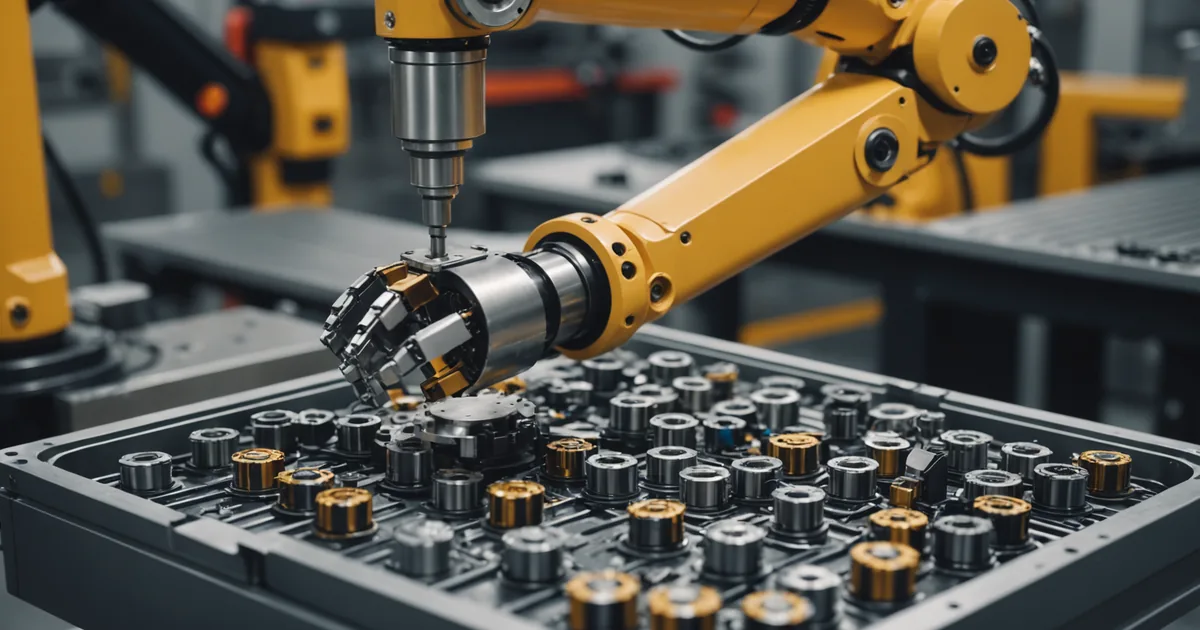
Pick-and-place from a structured bin to a fixture tray is the second most reliable first deployment candidate. The key variables are bin presentation consistency and placement tolerance. If parts arrive in a gravity-feed chute or a vibratory bowl feeder and land in a predictable orientation range, the arm's depth camera can locate the part reliably on each cycle. Fixture tray placement tolerances of plus or minus 2 to 3mm are achievable with a well-taught task and consistent part presentation.
This station type is particularly good for a first deployment because the cycle is short and highly repetitive, which makes the ROI math straightforward. A station running a 6-second cycle all shift benefits from even a 10 percent reduction in cycle time or downtime compared to manual performance. The main risk is part presentation variability at the extremes of the bin: if parts can arrive in radically different orientations depending on how the feeder fills, the task teach needs to account for that range, and the teach session takes longer.
Station 3: Assembly assist for a stable sub-assembly sequence
Assembly assist is less obvious as an early deployment candidate but works well when the sub-assembly sequence is stable and the holding or positioning function is well-defined. The classic use case: the arm holds a housing in a fixed orientation while a human worker inserts fasteners or applies adhesive. The arm's role is positional, not manipulative, and the cycle time is governed by the human's work, not the arm's motion speed.
The value here is not throughput replacement; it is ergonomic and quality consistency. Holding a heavy or awkward sub-assembly in a precise orientation for dozens of cycles per shift is exactly the task that causes cumulative strain injuries and introduces alignment variability into the assembly. The arm does it the same way every cycle. The human does the skilled work without fighting the part.
For this to be a good first deployment, the assembly fixture needs to be stable in design. If the sub-assembly geometry changes every three months with a new product variant, the assembly assist task needs retasking at each change. That is feasible but adds overhead. Best suited for your more stable product lines first.
Station 4: End-of-line quality orientation check before packaging
Many plants have a manual step at the end of a sub-assembly line where an operator picks each part, visually confirms orientation, and places it into a tray or conveyor in the correct attitude for the next operation or packaging. This is exactly the kind of task where visual-teach with depth camera part-pose estimation works well. The arm can be taught to pick each part, confirm its orientation against the depth camera's reference model, rotate it to the target orientation, and place it.
This is a good first deployment candidate because the value proposition is immediately visible: the arm does not get tired, does not miss an orientation error on the 400th cycle of a shift, and produces consistent tray fill patterns. The ROI case combines labor replacement with quality consistency. Some plants use this as a bridge task: the arm runs orientation check during production, then retasks to palletizing at end of shift. Two tasks, one arm, no integrator between them.
Station 5: High-repetition fastener or label placement on a stable fixture
Applying the same fastener at the same torque to the same position on a stable fixture is a task where the arm's repeatability advantage is most obvious. Screw driving, nut running, label placement: these are tasks where human operators achieve acceptable quality most of the time but introduce occasional errors from fatigue, attention variance, and torque inconsistency. The arm runs the same approach vector and contact force every cycle.
The main prerequisite is fixture stability. If the parts are held in a well-defined fixture with consistent loading, the arm can be taught the fastener position precisely. If the fixture has significant part-to-part positional variation, the arm's real-time pose correction from the depth camera needs to carry the slack, and you need to validate the correction range during teach.
Two station types that can wait
We also want to name the two station types we consistently recommend against as a first deployment, not because they are impossible, but because they are harder to land cleanly as a first engagement.
Highly variable bin pick. Bulk-loaded bins where parts can arrive in any orientation, nested with each other, or partially obscured by adjacent parts require significantly more sophisticated vision and grasp planning than a structured pick task. The technology exists, but the teach-and-verify cycle is longer, the edge cases require more iteration, and the task success rate under production variability is harder to predict. Better to establish confidence with a structured pick task first, then expand.
Fine-assembly requiring submillimeter placement. Tasks requiring placement precision under 1mm, such as electronic component placement or precision bearing insertion, are at the edge of what a collaborative arm without additional fixturing can reliably achieve. The arm's repeatability is good, but thermal variation, fixture tolerance stack-up, and part-to-part dimensional variation can all eat into the available placement window. These tasks can work with the right fixture design and careful commissioning, but they are not a forgiving starting point for a first deployment.
The common thread in the good first candidates is predictable geometry, moderate placement tolerance, and a task cycle that does not depend on adapting to unpredictable part variation. These characteristics are what make a teach session efficient and a production deployment reliable. As you build confidence with the arm and with the retask process, you can take on more demanding tasks. But the first station should be one where you can get to production quality in a single afternoon.
These station profiles are based on patterns we observed across our early-access pilot sites. Your specific geometry, part variability, and cycle rate will determine which of these profiles fits your situation. Before committing to a station, we recommend walking through the task with the actual parts at hand to assess whether the pick geometry and placement tolerance fall within the comfortable operational range for visual-teach deployment.