The Hardware
Built for the plant floor, not the lab.
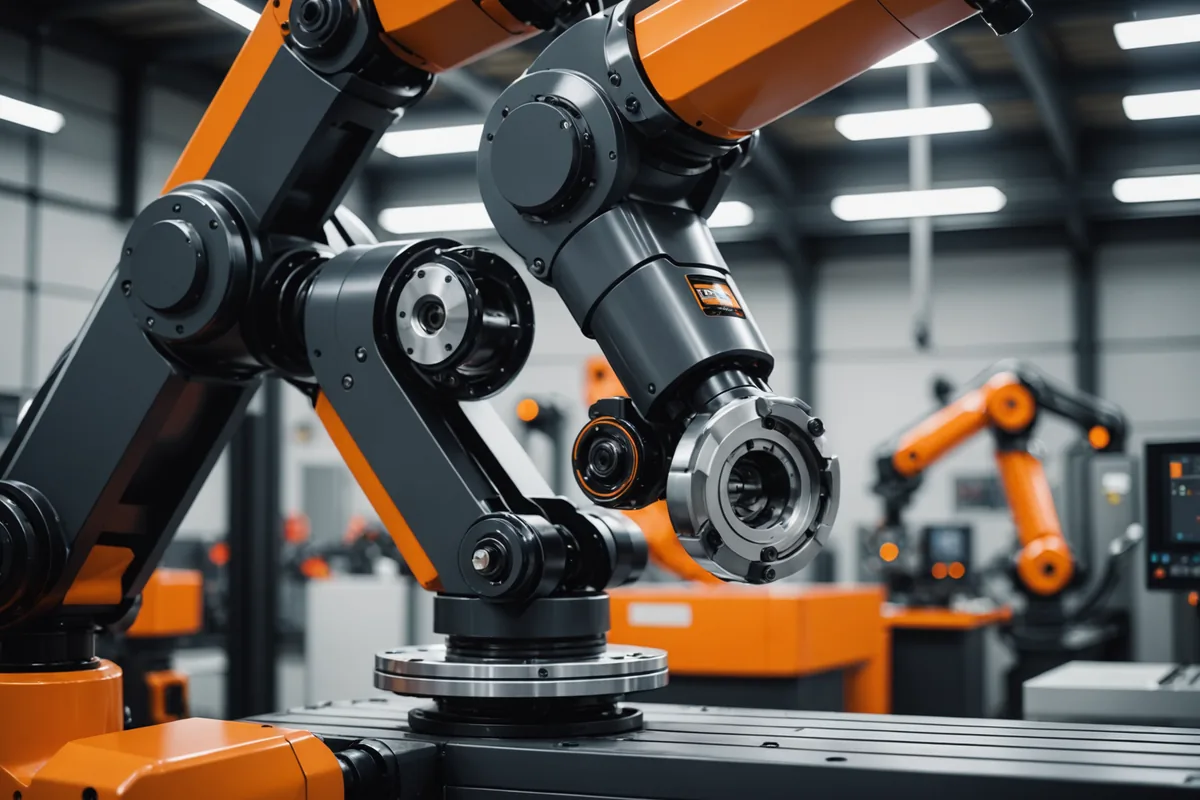
A 6-axis collaborative arm with on-arm AI inference, integrated depth camera, and visual teach mode. No teach pendant. No integrator. Your operators run it.
6
Degrees of freedom
8 kg
Maximum payload
900 mm
Reach radius
Technical specifications
Arm specifications
Production unit specs. All values reflect shipping hardware configuration.
Degrees of Freedom
6 DOF
Full wrist rotation included
Maximum Payload
8 kg
Measured at full extension
Reach Radius
900 mm
From base center
Repeatability
± 0.04 mm
ISO 9283 standard
Speed (max TCP)
2,000 mm/s
Trajectory-limited in teach mode
Depth Camera
Integrated
Structured-light, 0.5-1.5 m range
On-Arm Compute
Edge AI module
Inference at arm; no cloud dependency
Protocols
EtherNet/IP, Modbus TCP
PLC handshake out of box
Safety Standard
ISO 10218-1, PLd
Category 3 stop monitoring
Base Footprint
190 mm diameter
Direct-mount or pedestal
Power Input
110/240 VAC, single-phase
No 3-phase requirement
Arm Weight
28 kg
Base unit, no gripper

The AI Platform
Perception runs on the arm. Not in the cloud.
On-arm edge AI handles spatial reasoning, path planning, and collision prediction locally. No latency, no connectivity dependency, no per-inference cost.
Depth-aware path planning
The integrated structured-light camera builds a point cloud of the workspace on each cycle. The arm plans around real-time obstacles, not a static map.
Visual teach capture
Guide the arm by hand. The system records waypoints and generates a collision-aware trajectory automatically. Three confirmation cycles before production approval.
Part-variation tolerance
Trained on part-variation envelopes during the teach session. The arm compensates for part position and orientation shifts without re-teaching.
Force-torque awareness
Per-joint torque monitoring detects contact events. Used for assembly operations, surface following, and collaborative stop scenarios.
Safety and compliance
Safety designed in, not bolted on.
Every safety feature is standard. The reason is practical: a stop event that requires an engineer to diagnose costs production time.
ISO 10218-1 collaborative robot safety principles
Stop monitoring architecture designed with ISO 10218-1 collaborative robot safety requirements in mind. Dual-channel safety I/O with cross-monitoring and PLd-level stop logic per ISO 13849 design targets. Risk assessment documentation provided with every deployment.
Power and force limiting (PFL)
Per-joint torque limits enforced in hardware. The arm stops within 200 ms on contact above threshold. Compliant with ISO/TS 15066 collaborative operation limits.
Speed and separation monitoring
Workspace speed reduces dynamically as the depth camera detects a human presence in the monitored zone. No hard fence required for most tasks.
Documentation and risk assessment
ISO 10218-1 risk assessment template, installation record, and safety zone configuration parameters delivered with each arm. Technical file prepared in the format required for Machinery Directive conformity assessments. We work through the documentation with your safety team at commissioning.
Head-to-head
How the Walden arm compares.
Spec-for-spec against the traditional collaborative arm category. Relevant for mid-size plant deployment decisions.
| Feature | Walden Arm | Traditional Cobot |
|---|---|---|
| Task programming | Visual teach mode, operator-driven, afternoon deployment | Teach pendant + integrator, 3-6 week engagement |
| Depth camera | Integrated, structured-light, on-arm | Optional external vision system, separate install |
| On-board AI inference | Edge AI module on arm, no cloud | Cloud API or no vision AI standard |
| Retask by operator | Yes, guided UI with confirmation flow | No, requires integrator reprogramming |
| PLC integration | EtherNet/IP + Modbus TCP standard | Varies; often requires gateway hardware |
| Power requirement | Single-phase 110/240 VAC | Often 3-phase, dedicated circuit |
| Footprint | 190 mm base, direct-mount | 240-320 mm base, pedestal required |
| Safety standard | Designed to ISO 10218-1 PLd, Cat 3 safety targets, risk assessment included | ISO 10218-1 PLd standard, certification scope varies by model |
Bring the arm to your floor. One visit, one afternoon.
Request a Demo